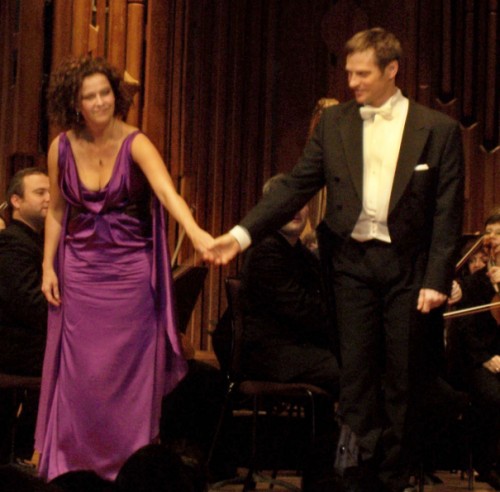
2008.11.03 – Operetta Night, Barbican Hall, London: Angelika Kirchschlager, Marc Minkowski
Viennese Operetta Night
3 November 2008
Barbican Hall,London

Simon Keenlyside
Angelika Kirchschlager
Marc Minkowski
Musiciens du Louvre
Johann Strauß II:
Egyptian March
Franz von Suppe:
Boccaccio – Hab’ ich nur deine Liebe (AK, SK)
Boccaccio – Mia bella Fiorentina (AK, SK)
Franz Lehár:
Eva – Zwanzinette
Emmerich Kálmán:
Das Veilchen von Montmartre – Heut’ Nacht hab’ ich geträumt von Dir (SK)
Johann Strauß II:
Die Tänzerin Fanny Eisler – Draussen in Sievering blüht schon der Flieder (AK)
Franz Lehár:
Gold and Silver (waltz)
Interval
Franz Lehár:
Giuditta – Meine Lippen, die küssen so heiss (AK)
Emmerich Kálmán:
Die Zirkusprinzessin – Wieder hinaus ins strahlende Licht (SK)
Johann Strauß II:
Die Fledermaus (overture)
Franz Lehár:
Zigeunerliebe – Nur die Liebe macht uns jung (AK, SK)
Emmerich Kálmán:
Die Csardasfürstin – Weisst du es noch (AK, SK)
Encores
Johann Strauß II:
Unter Donner und Blitz (polka)
Robert Stolz:
Der Favorit – Du sollst der Kaiser meiner Seele sein (AK)
Franz Lehár:
Das Land des Lächelns – Dein ist mein ganzes Herz (SK)
Emmerich Kálmán:
Die Csardasfürstin – Tanzen möchte ich (AK, SK)
Die Csardasfürstin – Weisst du es noch (AK, SK)
What the critics say
Tim Ashley, The Guardian, 7 November 2008
Angelika Kirchschlager and Simon Keenlyside spent last autumn touring Germany and Austria with a programme of excerpts from Viennese operetta. It was a high profile effort, with the faces of operetta’s dream couple, so called, gazing down from billboards everywhere. For the somewhat belated English follow-up, a few things had changed. There was less hype, for starters. More important was the acquisition of a new orchestra and conductor: Les Musiciens du Louvre-Grenoble and Marc Minkowski, an improvement on the South Austrian Tonkünstler Orchester under the routine Alfred Eschwé. Listening to Lehár, Strauss and Kálmán on period instruments allowed us to appreciate the dry pointedness of their satire, as well as their sensuality.
Operetta’s dream couple, however, weren’t always desirably matched. Keenlyside, as usual, sank into his material, while Kirchschlager kept her distance, posing and emoting a bit. Some of this music needs a soprano and she is a mezzo. In the big number from Lehár’s Giuditta, her declarations about the heat of her kisses weren’t matched by a blaze at the top of her voice.
Operetta suits Keenlyside, meanwhile, since it allows him to be sexy and subtle without all that theatrical angst. His singing is fresh and warm, his platform manner charming and gallant. During a drunken routine from Kálmán’s Die Zirkusprinzessin, he managed – whether by accident or design – to spill his beer and mop up the mess with his hankie, before impishly pouring the rest of the bottle into the bemused-looking Kirchschlager’s water glass. Later, he swept her across the platform in a series of delirious waltzes. Sweet.
Richard Morrison, The Times, 5 November 2008
A stonier heart than I would point out the perversity, in these straitened times, of using public subsidy to import a French orchestra and conductor to play frothy Viennese operetta extracts – primarily, it seemed, so that two highly paid singers could boost their CD sales of the same stuff. But such was the charm of this enterprise, so enthusiastic the audience response, and so seductive the tunes of Strauss, Lehár, Kálmán and Suppé, that such surly misgivings were easily banished.
The singers were the Austrian mezzo Angelika Kirchschlager and the British baritone Simon Keenlyside. Both are more accustomed to the sterner end of the operatic repertoire. But they revealed hitherto unsuspected shallows here – not just singing but waltzing and schmalzing their way through a succession of showstopping duets and arias from that fantasy Land des Lächelns where all men are rich but romantic rogues and all women tend to be Hungarian princesses disguised as fishmongers’ wives.
Perhaps because she has Salzburg blut in her veins, Kirchschlager seemed the more vivacious interpreter. She looked radiant, sounded lustrous (floating delicious pianissimo top notes) and pointed the text so well that even those with no German could get the gist – not that the gist was terribly complex.
Keenlyside was more gimmicky, mooching around with hands in pockets, and devoting his song from Kálmán’s Die Zirkusprinzessin to opening a beer, spilling it and mopping the stage with his hanky. One was only surprised, in this health and safety-obsessed era, that the show wasn’t stopped until a council inspector had certified the damp floor as fit for use. But Keenlyside also produced some ravishing singing – none better than in that sumptuous “Tauber lied”, You are my Heart’s Delight.
I wasn’t so impressed by Marc Minkowski’s Les Musiciens du Louvre-Grenoble. It was mildly interesting to hear this repertoire played on period instruments such as wooden flutes and narrow-bore brass. But there was little evidence of authentic Viennese style, especially the syncopated advance of the second beat in the waltzes. And Minkowski proved a stodgy, unresponsive accompanist. I liked his big black period baton, though


{ 0 comments… add one now }