1996, Geneva, Hamlet
Hamlet

Composer: Ambroise Thomas
Libretto: Carré and Barbier after a French version of Shakespeare’s tragedy by Dumas
père and Paul Maurice
Venue and Dates: Grand Théâtre de Genève
6 , 9, 12, 15, 17, 20 September 1996
Conductor: Louis Langrée
Directors: Patrice Caurier and Moshe Leiser
Sets: Christian Fenouillat
Costumes: Agostino Cavalca
Lighting: Christopher Forey
Performers:
Hamlet: Simon Keenlyside
Ophélie: Natalie Dessay
Gertrude: Kathryn Harries
Claudius: Alain Vernhes
Laërte: Yann Beuron
Ghost of Hamlet’s father: Markus Hollop
Marcellus: Alain Gabriel
Horacio: Franck Ferrari
Polonius: Louis Landuyt
Premier fossoyeur: Alexandre Diakoff
Deuxième fossoyeur: Jean-Louis Meunier
Le Roi de comédie: José Toti
La Reine de comédie: Yves Adam
Le Traître de comédie: Emilien Palenzuella
Orchestre de la Suisse Romande
Choeur du Grand Théâtre de Genève
Notes: Performance of 12.9. was broadcast
Click here for details of a DVD related to this production
Soundbites
An auspicious start to Geneva’s season.
Anne Midgette for Opera News, December 28 1996
http://www.metoperafamily.org/operanews/_archive/122896/reports.122896.html
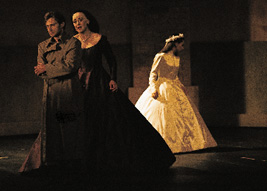
Thomas’ Hamlet is very much a product of its time; accordingly, Agostino Cavalca costumed the figures in 1860s-era attire. Christian Fenouillat’s sets were less successful: pieces of palace wall moved across the stage in a vain attempt to shield the characters from the yawning void of the empty black stage behind them. Where the interaction of characters was concerned, however, Patrice Caurier and Moshe Leiser’s direction was strikingly effective in places such as the confrontation between Hamlet and Gertrude in Act IV and the excellent scene with the traveling players, which, thanks to the skill of three good mimes, was as strong as ever I’ve seen it, even in Shakespeare’s version.
At the beginning, Simon Keenlyside’s voice seemed pallid in the title role, but he marshaled his resources for an impressive drinking song in Act II, going to the limit to show what he can do in the way of color and intensity. Kathryn Harries’ fine performance as Gertrude was marred only by a slightly throaty quality, which made it sound sometimes as if she were singing two pitches at once. On the other hand, her timbre contrasted ideally with the clear purity of Natalie Dessay as Ophélie. Though slightly wooden at times, Dessay sang beautifully, skillfully apportioning her energies so that there was always color at the top and plenty of steam left to deliver big, satisfying climaxes to each aria. Only when she had to begin her mad scene lying on her side in fetal position did a couple of technical hiccups appear in her approach to top notes.
As Claudius, Alain Vernhes displayed a beautiful instrument, but he didn’t always sing beautifully. Marcus Hollop was suitably large and stentorian as the Ghost. Conductor Louis Langrée maintained a light touch, but in some slow passages, such as the introduction to Ophélie’s Act II aria, the music started to dissolve rather than achieving transparency, and one felt that Langrée’s efforts at sensitive interpretation might degenerate into mere mannerism.


{ 0 comments… add one now }