2007, London ROH, Iphigenie en Tauride
Iphigénie en Tauride
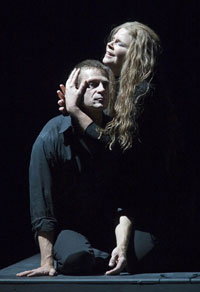
Composer : Christoph Willibald Gluck
Librettist : Guillard and Du Roullet after Euripides’ drama
Venue and Dates : Royal Opera House, Covent Garden, London
10, 13, 16, 25, 27, 29 September 2007
Conductor : Ivor Bolton
Director : Robert Carsen
Designs : Tobias Hoheisel
Lighting : Robert Carsen / Peter van Praet
Choreography : Philippe Giraudeau
Performers :
Iphigénie: Susan Graham
Oreste: Simon Keenlyside
Pylade: Paul Groves
Thoas: Clive Bayley
First Priestess: Gail Pearson
Second Priestess: Claire Wild
Diana: Cécile van de Sant
Scythian: Jacques Imbrailo
Servant: Krzysztof Szumanski
Notes : Click here for details of a related recording
Iphigenie en Tauride, DG 4711332
Click here to read an interview with Simon for musicOMH.com
Click here to read an interview with Susan Graham for musicalcriticism.com

Soundbites
Andrew Clark, Financial times, 11 September 2007
http://www.ft.com/cms/s/2/849a8af8-6083-11dc-8ec0-0000779fd2ac.html
One problem faces all Gluck interpreters: how do you extract the meat from the marble? It explains why we encounter his masterpieces so rarely, and why Monday’s performance of Iphigénie en Tauride – the first at Covent Garden for 35 years – was so uninvolving. Despite its tragic depths, its melodic abundance and dramatic variety, the work’s austerity is forbidding. Like a monument, Iphigénie has its weights and balances: heroic but intimate, grandly tragic without being frigid or marmoreal, weighty yet swift in its storytelling.
In trying to resolve these extremes Robert Carsen’s staging finds itself out of kilter on several fronts. Tobias Hoheisel’s design places the action within a monochrome box, its slate-black mass relieved only at the end to reveal a dawn of brilliant light, releasing Agamemnon’s daughter from her physical and psychological imprisonment. This tangled tale of blood-relationships, life-and-death situations and intensely shared experiences is clamped within a frame too unsparingly modish to engage the emotions.
It’s not just a fault of the staging. In his conducting of the Orchestra of the Age of Enlightenment Ivor Bolton leaves the impression of small-scale resources trying to fit a large-scale musical imagination. Bolton is trapped inside a Handel-to-Mozart time-warp, with a technical awareness of style but not the wherewithal to realise the music’s theatrical grandeur: the gestures sound small-scale. He glides over the silences that are an essential part of Gluck’s design, not least before Orestes’ Act Four aria. The OAE nevertheless makes a brilliant showpiece of the opening storm music.
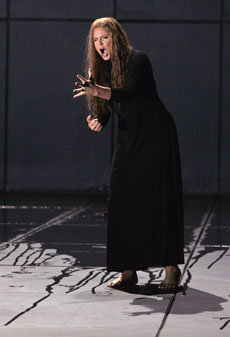
Susan Graham’s Iphigenia starts with a tall figure and excellent French, neither of which she uses to advantage. She wanders the stage like Elektra’s alter ego, adopting stand-or-sit poses for her arias but never really delivering. The voice sounds unexpectedly pretty at the top but impersonal in the middle; she makes no effort to colour the text. On that score she could learn a thing or two from Simon Keenlyside, who has only to open his mouth or move an arm to shake up the performance. His Orestes, strongly supported by Paul Groves’s Pylades and Clive Bayley’s Thoas, offers a vision of what this Iphigénie could have been with a bit more meat on the slab.
Dominic McHugh for musicalcriticism.com, 10 September 2007
http://www.musicalcriticism.com/opera/roh-iphigenie.htm
Life is rarely black and white, especially in Ancient Greek drama.
But Robert Carsen’s new production of Gluck’s Iphigénie en Tauride would have us believe otherwise. Carsen treats the drama as a black void into which no light spills until the gods’ anger is quelled in the closing tableau of the opera, when the stage is suddenly illuminated. In itself, this is a powerful moment, though it’s a long time coming. Other aspects of the production work well intermittently; one can see, for instance, that the drama is all inside Iphigénie’s head, and the use of mime to depict dreams, visions and predictions (such as Iphigénie’s opening narrative) is clever enough.
But otherwise, I found this Iphigénie scarcely less tedious than the Royal Opera’s production of Pelléas et Mélisande earlier in the year. Three black walls were all that we were treated to for two and a quarter very long hours. The chorus was consigned to the orchestra pit and replaced by dancers onstage; this is totally against one of Gluck’s major operatic revolutions, namely the greater integration of the chorus into the drama. In the early scenes, the names of Iphigénie and her parents, Clytemnestre and Agamemnon, were written in chalk on the walls, with Oreste’s (her brother) on the heavily raked stage floor; these names were later rubbed out symbolically by the dancers, but it hardly made for gripping theatre. The lighting (by Carsen and Peter Van Praet) was so dim that most of the time the singers’ faces were indistinguishable. Coupled with the black costumes of Tobias Hoheisel (who was also the set designer), this homogenised the characters and made the drama devoid of personalities. By favouring the psychological over the classical – though some will probably feel that the square walls, the square drawn on the stage floor and the ‘Greek chorus’-style dancers were classical – Carsen fatally overlooked one of the most important elements of this opera. There was no colour, no life, no contrast and nothing to engage with. For me, this was a very dreary experience that started nowhere and went nowhere very slowly, and from the mixture of booing and cheering at the curtain calls, it seems I was not alone.
Disappointing, too, was the music. With three fantastic singers, an expert in music of the period and the Orchestra of the Age of Enlightenment, the potential for success was great. But the same problems that I had with Ivor Bolton’s conducting of Don Giovanni earlier in the year recurred here. Extreme tempi, often ponderous but sometimes too fast to allow the singers to breathe, bass-heavy and violin-light orchestral balance and a lack of dynamic contrast characterised an uneven reading. The OAE played beautifully and evidently has great respect for Bolton, and the benefit of having period instruments was especially brought home by the distinctive timbres of the woodwind instruments. But a lack of space and flexibility, and generally weak co-ordination between stage and pit, gave the singers a vulnerable environment in which to perform.
Neither Susan Graham nor Simon Keenlyside were at their best in this performance, even though they were still excellent. The tessitura of the role of Iphigénie is occasionally a little too high for Graham, so she sounded strained and exposed once or twice in a way that was unusual for her; this was partly the product of the unresponsive conducting, however. There was a spellbinding quality about her voice, and her aria at the start of Act Four drew deserved applause, but this was not her night. Similarly, Keenlyside’s Oreste was uncharacteristically hard pushed by some of the music and the ease of his treacly baritone was not quite there at times. The production was to blame in many respects, requiring him to sing while lying flat on his back or after climbing up a wall sideways or with his back to the audience. And from my seat, the OAE often sounded too loud for all the singers, which, considering the small size of the orchestration, is saying something.
Tenor Paul Groves produced some of the most stylish singing of the night, and his performance of Pylade’s aria at the close of Act Three drew the first applause of the night after the interval. He has a feel for the French declamatory style of the score and the right tonal attributes in his voice for the part.
Other than those three, the only singer really to impinge on my consciousness was baritone Jacques Imbrailo, one of the Royal Opera’s Young Artists. Playing A Scythian, he excelled in his brief appearance thanks to strong projection and his perfect accent. The other singers were all more than adequate vocally, but they seemed like ciphers because of the bleak production.
It has been a dark week for the Royal Opera, with first Bryn Terfel backing out of the Ring Cycle and now this disappointing new production. Let’s hope things improve when the Ring takes to the stage in October.
Simon Thomas, musicOMH.com
http://www.musicomh.com/opera/roh-iphigenie_0907.htm
Rating: Four out of five stars
From the moment that Susan Graham wafts slowly downstage during the overture, the Royal Opera’s new production of Gluck’s Iphigénie en Tauride has a striking, if stark and bleak, beauty.
Black is the dominant mood and colour, with no visual relief bar the occasional slash of light which scars the surrounding gloom, entrapping the protagonists just as they are imprisoned by their past actions.
Based on Euripides, it takes up the story of Iphigénie, the daughter that Agamemnon sacrificed on Aulis in order to send his fleets off to besiege Troy. Whisked away from the sacrificial altar by the goddess Diana, Iphigénie finds herself installed as High Priestess on the island of Tauris, under the tyrannical rule of King Thoas.
Having murdered his mother Clytemnestra (who in turn had done away with her husband Agamemnon), Iphigénie’s brother Oreste, plagued by the avenging Furies in the wake of his matricide, arrives in Tauris where, unrecognised by his sister, he becomes Thoas’ latest sacrificial victim. What is played out in Euripides’ play and Gluck’s opera is the tumultuous states of mind of these people, each desperately seeking relief from their torments.
Robert Carsen’s production leaves us in no doubt that Thoas’ kingdom is a savage and unforgiving domain. The chorus act out a repetitive, splashing dumbshow of killing and Clive Bayley’s king stalks the stage like a Victorian melodrama villain.
Susan Graham, a magnetic stage presence, is simply peerless in French repertoire and this represents a very welcome return for this artist after too long an absence. Her expressive, rich and very beautiful mezzo fills the house, although there were signs of strain at the high end of her register on the opening night.
As the lookalike friends who take male bonding to an extreme, each pleading to die for the other, Paul Groves and Simon Keenlyside exude both masculinity and vulnerability. Keenlyside’s Oreste is like a tortured animal, screwing himself into knots of agony as his psychological furies tear him apart. Ever demonstrative, he levitates and walks across a vertical wall while singing. American Tenor Groves as Pylades sings some of the most lyrical material in the work with great loveliness.
After a far less auspicious Don Giovanni at Covent Garden a few months ago, Ivor Bolton returns to draw an immaculate performance, at once incisive and driving, from the guesting Orchestra of the Age of Enlightenment.
If this is impressive musically and extraordinary visually, the whole performance is also oddly unengaging. With emotions writ so large, it’s difficult to relate to the characters or the situations on a basic human level. Just before the brother and sister reveal their identities to each other, Oreste is moved by the simple compassion shown by an apparent stranger, and we are too. But it is a fleeting moment amidst an unrelenting Sturm und Drang onslaught that is draining to watch.
We are not allowed in to the world onstage but can only look on in wonder, and at times horror, so there is little sense of catharsis or any real involvement. Ultimately, this is a production to be admired rather than loved.
Rupert Christiansen, Telegraph 12 September 2007
http://www.telegraph.co.uk/arts/main.jhtml?xml=/arts/2007/09/12/bmopera112.xml
A stark masterpiece made more difficult
What a pity that the Royal Opera’s new production sells it so short.
Iphigénie en Tauride is a sharply focused drama on the themes of the demands of honour and self-sacrifice, in which an appalling moral dilemma is resolved by a god’s sudden arbitration. Gluck’s score is of a severe beauty and clarity, without superfluous decoration or display.
The emotions expressed by the characters are intensely sincere: there is no room for irony, subtlety, contradiction or comedy, virtue and vice are absolutes, and the conclusion is abruptly final.
This is not a world we readily understand, and its unwavering moral earnestness isn’t easy to present on stage to a modern audience: how do you make such unmodulated unambiguity interesting? The director Robert Carsen doesn’t even try.
His production, designed by Tobias Hoheisel, is bleak in the extreme — simple black costumes for everyone, the set an unadorned charcoal box, dripping with blood, which opens only when the dea ex machina sorts out the mess.
The chorus sings from the pit, their place taken on stage by a troupe of barefoot dancers, running around and banging themselves against walls, as prescribed by Philippe Giraudeau’s vacuous sub-Ultima Vez choreography.
It’s efficiently executed and coherent as an interpretation, but too empty, too abstract, and too dark to engage one’s attention or sympathy. Where is this happening, who are these people and why are they behaving like this? Rather than trying to animate the drama by addressing these questions, Carsen paints it flat and ends up draining it of life.
A stronger tragic actress in the title role could have made a difference – that nice, sunny, warm-voiced American mezzo-soprano Susan Graham failed to carve a deep true line through her wonderful Act 2 aria, and her declamation was vitiated by mushy French. Simon Keenlyside (Oreste) and Paul Groves (Pylade) both shouted more than they sang, turning their eloquent Act 3 duet into a militaristic bellow.
The chorus sounded muted, and Ivor Bolton’s conducting of the Orchestra of the Age of Enlightenment was flaccid.
Buy Marc Minkowski’s enthralling Archiv recording if you want to experience this opera’s power. [Click here for details: Ihpigenie en Tauride CD]
George Hall, The Stage, 11 September 2007
http://www.thestage.co.uk/reviews/review.php/18185/iphigenie-en-tauride
The Royal Opera season begins with Robert Carsen’s production of Gluck’s 1779 masterpiece, a work not seen at Covent Garden since 1973. It’s a hard piece to bring off.
Above all, the declamation of the text needs passion and intensity, and without any French singers in the cast that is a tall order.
In the vital title role, Susan Graham is all too cool as the tormented daughter of Agamemnon who comes close to sacrificing her long-lost brother, Oreste, until his identity is revealed at the last minute. More vocal colour and variety are needed than she can supply.
More of these qualities are to be found in Simon Keenlyside’s performance as her brother and Paul Groves’ interpretation of his friend Pylade. Their scenes come through with some impact. As the barbaric King Thoas, Clive Bayley presents a one-dimensional villain and his tone is rough.
But what really scuppers the evening is Carsen’s production, to monochrome designs by Tobias Hoheisel. Having the chorus sing behind the scenes diminishes their impact, while the endless black of both sets and costumes adds a spurious seriousness to proceedings missing in the staging itself. A show this long needs more some variety.
The Orchestra of the Age of Enlightenment plays efficiently, but Ivor Bolton’s conducting lacks vigour. This piece is supposed to be one of the great achievements of eighteenth-century opera, but it doesn’t register as anything like that on this occasion.
Alexander Campbell for classicalsource.com, September 10, 2007
http://www.classicalsource.com/db_control/db_concert_review.php?id=4897
The Royal Opera has come up with a brilliant solution by importing Robert Carsen’s stark but atmospheric staging of “Iphigénie en Tauride” – written in the 1770s for Paris by the much-travelled Christoph Willibald Gluck (1714-1787) – first mounted in Chicago and San Francisco, and also bringing the Orchestra of the Age of Enlightenment in to free the ROH Orchestra the necessary rehearsal time for Wagner.
Gluck’s operas have not been seen much at Covent Garden (“Iphigénie en Tauride” last in 1973 conducted by John Eliot Gardiner), so it is good to encounter one of his works in a staging. For this one Tobias Hoheisel provides a tall single-unit box design set, which allows space for the performers, and yet also manages to be claustrophobic enough for the more intimate scenes, thanks to some very effective lighting. True to the drama’s origins in ancient Greek theatre there is an energetic “chorus” / movement group that helps propel the principals around as well as providing strong visual enactment of the Furies. The use of this group is controlled enough to prevent distraction or, worse, becoming tiresome. Carsen’s approach may not please all, but it gets to the core of the work with an engaging directness.
A successful performance of this opera, which is essentially a drama of emotion rather than of action, is highly dependent on its three main protagonists. By engaging Susan Graham as the heroine, who performed in this production in the American performances and has long experience of the role in other stagings, the pivotal central role was completely realised. Graham is very much in her vocal prime and the role sits well in the rich and velvety middle part of her voice, and her excursions into the higher reaches were managed without strain. Words and coloratura were used to great effect. She’s also an intense and appealing performer who knows how to use stillness and body language to great effect. Iphigénie’s attraction to Oreste was enacted with pathos and not without an erotic undercurrent as well, and this made their final recognition scene – the stuff of any operatic Greek tragedy involving any member of the house of Atreus – very moving.
That she also had Simon Keenlyside and Paul Groves playing Oreste and Pylade respectively lending marvellous vocal and dramatic support was fortunate. Both of similar physical stature and looking almost twin-like they acted the guilt-ridden prince and his faithful friend to the full. Keenlyside once again giving a performance of great physicality, showed off his bronzed baritone to effect and, singing in impeccable French, delineated his character’s emotional turmoil fully. ‘Le calme rentre dans ma coeur’ was something of a tour-de-force, the highly agitated ending contrasting with the character initially seeming calm. His emotional collapse as he states that death would be relief from the madness he was suffering, coming at the end of Oreste’s impassioned argument with Pylade over which should sacrifice their life for the other, was a telling moment. Paul Groves, another singer experienced in this production, delivered a virile and engagingly sung account of the devoted and occasionally uncomprehending Pylade, and excelled in his solo numbers which were sung in a plaintive and covered tone. The implied depiction of Pylade as the alter ego of Oreste added an interesting dimension to his portrayal.
In the smaller roles Clive Bayley made much of little as Thoas, and the lush tones of Cécile van de Sant’s Diane contributed much to the final scene. The Royal Opera Chorus was on fine form, although the placing away of these singers produced some odd acoustic echoes in some parts of the House.
Ivor Bolton proves himself an excellent Gluck conductor and his reading had pace, variety and sweep. From the short introduction and orchestral storm that opens the work the OAE players were wonderfully responsive. The underlying bass lines underpinned the body of sound, and the violas were allowed to sing out their contributions. Only the somewhat intrusively watery oboe disappointed. So a successful, bold and imaginative start to The Royal Opera season.
Warwick Thompson, Bloomberg, 12 September 2007
http://www.bloomberg.com/apps/news?pid=20601088&sid=aDF6OlEaYHLo&refer=muse
High Priestess Orders Death, Chorus Hides in London `Iphigenie’
Gluck wrote some fabulous music for the chorus in “Iphigenie en Tauride.” It would be dramatically sensible, if not plain courteous, to let the audience hear it.
There is no such logic at the Royal Opera, with the director Robert Carsen stuffing the chorus out of sight under the stage. They sound muffled and despairing. Carsen doesn’t even let them take a bow at the end. If I were a chorus member, I’d sue.
Carsen wants to create a minimalist psychodrama. Based on a play by Euripides, the opera tells the story of the high priestess Iphigenie who must sacrifice strangers arriving on her island.
One of them turns out to be her long-lost brother, Oreste, tormented with guilt for the killing of their mother. Iphigenie refuses her deadly duty, and is threatened by the king. The goddess Diana saves the day with a ban on further bloodshed.
The music is direct and intense, and the characterization pitched at a level of sculpted tragic grandeur. It’s not entirely inappropriate to see the piece as a play on psychic states of guilt, love and fear.
In a production previously seen in Chicago and San Francisco, Carsen has chosen a bare black-box set designed by Tobias Hoheisel, all-black costumes, and severe lighting. It’s plain, hard and claustrophobic. The only props are swords.
There are benefits to this approach, but ultimately it limits rather than liberates the work, and looks as dull as ditchwater. The invisible chorus is replaced on stage by dancers representing vengeful mobs and groups of handmaidens.
Rich Texan
Tall Texan mezzo Susan Graham makes an impressive Iphigenie. She has rich vocal resources for the role, and acts in the grand, gestural style required.
Baritone Simon Keenlyside is forceful as the priestess’s brother Oreste, while occasionally sacrificing the elegance of French style for melodramatic gasps and groans. Sometimes his performance works, and sometimes it’s way over the top. At least it’s never boring. Fresh-voiced tenor Paul Groves is excellent as Oreste’s friend Pylade.
Ivor Bolton conducts the Orchestra of the Age of Enlightenment, and the musicians relish all the psychological brilliance of Gluck’s orchestration. Occasionally Bolton’s energy topples into hastiness and the singers have to play catch-can.
It is still worth catching for the musical pleasures. Just spare a thought for the chorus — because you certainly won’t see them.
Geoff Brown, The Times, 12 September 2007
http://entertainment.timesonline.co.uk/tol/arts_and_entertainment/stage/opera/article2431739.ece
Things are pretty rum when colour arrives on stage only with the flowers in the prima donna’s bouquet. Yellow! Red! And wasn’t that green? Such a relief from the black hell we’d been trapped in. Black floor, black clothing, black blood, boxed in by three black walls: that is the operating space in Robert Carsen’s gruelling take on Gluck’s last masterwork, a production given its premiere in Chicago last year (San Francisco saw it this June).
If it hadn’t been for the lighting – shaded white, conjuring giant shadows – or the walls’ graffiti of character names, what would there have been to pick out?
Carsen’s reasoning for stripping away period settings in his opera productions is familiar. Historical clutter distracts and distances; the austere and contemporary sharpen the focus on universal emotions.
But when audiences are alienated through endless tragic poses and tortured choreography in a set with the charm of a Bronx basketball pit, the argument falls down. This was a bad and chilly night at the opera.
Even with Gluck’s music? Some warmth and redemption there, certainly. Singers occasionally need greater room for expression than Ivor Bolton’s swift beat allows, and the Royal Opera Chorus deserves to be liberated from the pit. But the glow and spunk of the Orchestra of the Age of the Enlightenment bring their own delights, even pitched against stage gloom.
And the cast isn’t short of the right juice. Simon Keenlyside, stopped by a bad back from appearing in Chicago, fulfils expectations as the bloodied Oreste, blown by a storm into another Ancient Greek mess. He’s virile, anguished, physically ideal. Paul Groves as his friend Pylade (Carsen avoids a gay subtext) isn’t far behind. Clive Bayley’s Scythian king Thoas is also a tonic, easily suggesting by his brutish voice someone who might just eat people for breakfast.
Over Susan Graham’s Iphigénie, the centrepiece role, hangs a question mark. She’s the veteran of this production’s past incarnations and her authority is secure, particularly in Gluck’s exceptional lamenting aria closing Act II. Even so, there’s a level beyond which Graham doesn’t go. Her kind of suffering is suffering by numbers. It’s finely enacted, and locked into the notes, but we’re not scalped; she’s not taking Iphigénie’s agony personally. Unlike the late Lorraine Hunt Lieberson, Graham is no natural tragedienne.
Inevitably this limits the opera’s drama. Not as much, though, as those sets and costumes (Tobias Hoheisel is responsible) or the silly choreography of Philippe Giraudeau. Or Carsen’s belief that black on black, gloom on gloom, is the best path to enlightenment.
Edward Seckerson, The Independent, 14 September 2007
http://arts.independent.co.uk/theatre/reviews/article2962130.ece
A woman in black emerges and makes her way slowly downstage. This is Iphigenie; her name is chalked up on the back wall by a shadowy group of other women. All hell then breaks loose. A terrible storm shakes the orchestra, orange light floods the stage, and a recurrent nightmare replays in Iphigenie’s imagination: the murder of her father, Agamemnon, by her mother, Clytemnestre, in turn despatched by her brother Orestes. And because blood is thicker than water, Robert Carsen, the director, splashes bucketfuls of the latter all over the stage as if to remind us that it might be possible to wake from this bloodbath.
Only minutes into Gluck’s Iphigenie en Tauride and already you are thinking: “Follow that.” Carsen does, but – and it is a big “but” – he essentially takes the Greek chorus out of the Greek tragedy, and casts it into a parallel underworld offstage, where it can only be heard. How diminished its impact is as a result is the big issue here.
From a musical standpoint, the force and immediacy of Gluck’s choral writing is compromised by its remoteness. In the lachrymose finale of act two, where Iphigenie, convinced that her entire family is now dead, proclaims “Let us now mingle our mournful cries” and Gluck responds with a great ensemble pierced by the pain of a single oboe, collective power is everything.
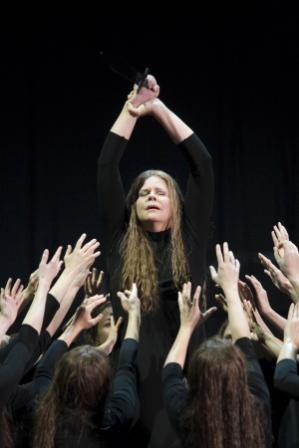
Instead, Carsen pulls visual focus on his dancers. They are the physical embodiment of his chorus, a shoal of writhing, seething, bodies whom choreographer Philippe Giraudeau treats as an expressive underpinning of the sung text. One could argue that this is an opera about isolation, and the extra physical dimension is too much of a distraction. I didn’t. I thought it lent the staging an impulsive energy.
Simon Keenlyside is Orestes, full on as ever, though he should beware that body language does not dictate feeling and thought, but rather the other way around. Paul Groves was immensely truthful as Orestes’ friend Pylade, his singing resolute and direct.
Gluck’s score – realised with such immediacy by Ivor Bolton and the Orchestra of the Age of Enlightenment – bristles. Gluck’s nose for atmosphere and dramatic timing is everywhere. And Susan Graham’s superb Iphigenie played the moment to perfection. She didn’t wear her grief and anger in this performance, she carried it within herself.
Colin Anderson for theoperacritic.com, 10 September 2007
http://theoperacritic.com/tocreviews2.php?review=ca/2007/rohiphtau0907.htm
High art opera seria
…The plot, as so often, is risible – “To obtain favourable winds for the Greek fleet at the beginning of the Trojan War, Agamemnon sacrificed his daughter Iphigénie to the goddess Diane. Iphigénie, however, was secretly saved by Diane, and sent to Tauris to serve as her priestess.” To make a longer story shorter, Clytemnestra, Iphigénie’s mother, kills Agamemnon for offering their daughter and, then, Oreste (Iphigénie’s brother) kills Clytemnestra to avenge his father’s death. Meanwhile, Thoas, King of Tauris, has ordered that Iphigénie should kill all strangers … next to arrive on Tauris is the shipwrecked Oreste in the company of his friend Pylade. There follows much intrigue, heart- and soul-searching and death-would-be-a-release sentiments; finally comes the mutual recognition by the siblings, the appeasement of the gods and, believe it or not, a happy ending.
That brightening is signalled by the lifting of the three sides of walls to reveal blinding light. Up to the conclusion the set has been dark, oppressive, claustrophobic, mostly black, sometimes grey, with much play made with shadows, and occasionally lit in red. A troupe of actors and dancers is also employed – they make a big dramatic splash (literally) in the action-filled opening, much knifing of victims (a colourless liquid rather than blood).
Robert Carsen’s production is new to Covent Garden, but was first seen at the Lyric Opera of Chicago last September and in San Francisco this June. Philippe Giraudeau’s choreography is vivid and elemental, the lighting by Peter Van Praet suitably crepuscular, Tobias Hoheisel’s black-wall sets and black costumes are suitably marmoreal and Robert Carsen’s direction (he is co-credited with the lighting) opts for a timeless symbolism … this was then, this is now, the story has its parallels today.
One can have doubts as to the minimalist singularity of the staging, yet it is effective even if the ‘action’ of the opening and the graffiti – spelling out the names of Iphigénie, Agamemnon and Clytemnestra – promises a variety that is not delivered; although this does make the white-bright-light deliverance all the more welcome.
To match the instrumental excellence in the pit (which also houses the unseen chorus) is some superb singing – from Susan Graham (Iphigénie), Simon Keenlyside (Oreste), Paul Groves (Pylade) and Clive Bayley (Thoas); each is in fine voice and carries into the auditorium effortlessly – balance with the orchestra is spot-on – and singing with belief and character. Some of the arias are exquisite, the colourful scoring and dance rhythms (when they occur) remind of Rameau (Gluck looking back and maybe honouring the French master) and using the orchestra with dramatic skill.
This is high-art opera seria, not perhaps the obvious way to open a new season, but the capacity audience seemed spellbound by the music – much slow and interior-bound – and certainly by the artistry of the singers and players.
Sunday Telegraph, 16 September 2007
‘Mighty passions at boiling point’ was the phrase one of Gluck’s librettists used to describe the mature output of the great opera-reforming composer. It sprang to mind again at Covent Garden on Monday, when the season opened with Gluck’s Iphigénie en Tauride. For a few minutes the stage seemed indeed to be on the boil as dancers writhed around to the extraordinarily daring and turbulent music with which this masterpiece begins.
In a staging as stark as Robert Carsen’s new production, Iphigénie makes for a slightly downbeat opening to the season, but it was still eagerly anticipated: Gluck’s opera had not been done by the Royal Opera since 1973, though it featured in a one-night stand there by the English Bach Festival, 15 years ago. Monday also marked the belated Covent Garden debut of the director, Carsen, whose often rather chic work has been seen in every other major opera house.
A pity, then, that Iphigénie (a co-production with Chicago and San Francisco) turns out to be Carsen at less than his most stylish, or insightful. Putting all those dancers on stage, he banishes the chorus to the pit, a sure way of emasculating the drama. As the dancers dominate the stage, it is odd that Philippe Giraudeau, the choreographer, lets them off so lightly: they do a lot of lying around.
Tobias Hoheisel’s set consists of little more than a towering black box, on whose walls the names of Iphigénie, Agamemnon and Clytemnestra are chalked in huge capitals. Members of the audience with fond memories of student productions will thrill to the deeply meaningful splashing about of water, but the rest may tire of the all-black costumes and the overly simple metaphor for Iphigénie’s psychological imprisonment. It’s the first time in this work that I’ve felt impatient with the plot: why, for heaven’s sake, can’t Oreste just reveal his true identity to his sister and let us all go home?
However, if he did, we would miss much fine singing from a cast led by Susan Graham’s Iphigénie. Slightly stretched at the top, she is nevertheless mesmerising as the neurotically haunted priestess, and sings her great lament with compassion. Simon Keenlyside, though not in freshest voice, delivers a characteristically intense performance as Oreste, and Paul Groves is ardent as his comrade, Pylade. Yet the evening is memorable above all for the playing of the Orchestra of the Age of Enlightenment under Ivor Bolton, who supplies drive while ensuring airiness and fluidity. Making a rare visit to the Covent Garden pit, they shape Gluck’s aching phrases with naturalness, colour and definition that would be impossible on modern instruments.
Anna Picard, Independent on Sunday, 16 September 2007
http://arts.independent.co.uk/music/reviews/article2968758.ece
Royal Opera’s violent staging of ‘Iphigénie en Tauride’ is not one which Gluck would have understood
As the Royal Opera House prepares for its forthcoming Ring Cycle, Iphigénie en Tauride offers an interesting contrast. Severe and beautiful, Gluck’s second Iphigénie could not have been written for any city other than Paris. For Agamemnon and Clytemnestra are not the only ghosts to haunt this opera. Also present are Lully, Rameau and Charpentier, masters of the tragédie lyrique, and Racine and Voltaire, while Iphigenia – who was sentenced to death at the close of Iphigénie en Aulide, then rescued by Diana and condemned to murder any strangers who arrive on the shores of Tauris – is herself a living ghost.
Framed in a vast charcoal box, and lit to a pupil-dilating perpetual dusk, Robert Carsen’s modern-dress staging, though beautifully choreographed and designed, shows mistrust of his audience’s ability to understand either Iphigenia’s backstory or Gluck’s aesthetics. With the chorus singing from the pit, dancers re-enact the deaths of Agamemnon and Clytemnestra: drawing knives across throats, dashing heads against walls, splattering the matt black surfaces with great blooms of glistening wetness.
Carsen’s thesis appears to be that Orestes and Iphigenia are suffering from post-traumatic stress syndrome, a diagnosis that Gluck, who dealt with the unmedicalised abstracts of guilt and sorrow, would not have understood. Though their love is as chaste as the Bach gigue Gluck references in Iphigenia’s final aria, “Je t’implore et je tremble”, Iphigenia (Susan Graham) is here a shivering, prematurely-aged girl-child, while Orestes (Simon Keenlyside) repeatedly writhes in horror at the memory of his matricide. When Diana (Cécile van de Sant) restores order, both siblings are left reeling by the magnesium-bright light that surrounds them.
If the staging is too brutal, too didactic, the singing is largely seductive, most particularly from Paul Groves (a lyrical Pylades) and Jacques Imbrailo (Scythian). Orestes is a role Imbrailo might consider, as the simplicity of his singing would be a better fit for this part than Keenlyside’s now over-mannered style. In the title role, Graham’s gorgeous, creamy, flexible sound is unconnected to her fragile, trembling characterisation, while Clive Bayley’s Thoas is an unnuanced snarler. In the pit, the Orchestra of the Age of Enlightenement were slow to warm up under Ivor Bolton, then impressive. Were they raised a little, I suspect Gluck’s alchemy of austerity and sensuality might be more impactful from the off-set. As it is, Iphigénie is a muted beginning to the 2007/8 season.
Anthony Holden, The Observer, September 16, 2007
http://music.guardian.co.uk/classical/reviews/story/0,,2170108,00.html
Where there’s Gluck…
A new Iphigenie is a triumph. No wonder it was booed
Though born German, Christoph Willibald Gluck proved the great 18th- century reformer of opera along French lines. Disenchanted with the fossilised content of Italy’s opera seria, and the repetitive excesses of its opera buffa, Gluck yearned for authentic human passions to be portrayed on stage with a ‘beautiful simplicity’, shifting the centre of gravity back from showy singers and florid visuals to music of exquisite beauty, performed without distractions. And that’s exactly what he gets in the distinctive first production of the Royal Opera’s new season.
With his designer Tobias Hoheisel, Canadian director Robert Carsen has created a dark, starkly monochrome visual world for Gluck’s Iphigenie en Tauride, lending an urgent, elegant intensity to the performances of its black-clad cast. This is as brave as it is original; the handful of boos when Carsen took his curtain call were a reassuring sign that he’d upset the traditionalists by doing away with Grecian robes and desert-island palm trees, replacing them with an unadorned open space allowing the music room to breathe.
In the aftermath of the Trojan war, Agamemnon’s supposedly sacrificed daughter has fetched up on Tauris, post-Aulis, to be ordered by its paranoid leader Thoas to exterminate all male strangers. When one such turns out to be her brother Orestes, whom she believes to be dead, complications naturally ensue. There’s a happy ending, unusually enough for any opera, but many an agony to go through en route.
With sleek choreography from Philippe Giraudeau, Carsen tells the backstory up front in a tableau that sees the principals’ names inscribed on the walls as graffiti. As Agamemnon and Clytemnestra get rubbed out (in dumb show), so do their names, leaving only Iphigenia’s. For a while. So dark and dramatically shadowy are the proceedings that the blinding light at the end, to greet the resolution of these knotty, very human problems, really does seem to hail a new dawn.
In the title role, American mezzo Susan Graham gives what may well prove the performance of her career, despite the stringy wig obscuring her well-preserved, blonde-bombshell looks. As her brother, the perfect match for her lyric eloquence and stage virtuosity, Simon Keenlyside’s athletic skills are unusually deployed in a horizontal walk along the walls.
The high standards are matched in the pit, where the chorus lies hidden as Ivor Bolton teases every rich, new vein of Gluck’s score out of the Orchestra of the Age of Enlightenment. This production is one of those rare evenings where the director accords the music the precedence it deserves, freeing it to demonstrate opera’s unique power to plumb deep into the human psyche.
Hugh Canning, Sunday Times, 16 September 2007
http://entertainment.timesonline.co.uk/tol/arts_and_entertainment/stage/opera/article2441202.ece
Dark and handsome
Susan Graham brings charisma to a haunting staging of the neglected Iphigenie en Tauride
As the music starts, blood drips down the back wall of an abstract, prison-like set. When the music gets more agitated, a “chorus” of black-clad dancers scrawl the names of Agamemnon, Iphigenia and Clytaemnestra in chalk, then reenact the sacrifice of Iphigenia by Agamemnon and the slaughter of the king of Mycenae by his vengeful queen. Gluck’s tragédie of 1779, Iphigénie en Tauride, one of the supreme masterpieces of neoclassical opera has returned to the repertoire of the Royal Opera for the first time in 34 years, in a relentlessly dark, physical and emotionally harrowing staging by Robert Carsen. Already seen in Chicago and San Francisco, it stars the Iphigenia de nos jours, the American mezzo-soprano Susan Graham.
A neglected rarity until quite recently, the piece is a powerful drama of family blood guilt, revenge and atonement. The Mycenaean princess is spirited away to a barbarian land (Tauris), where she is forced to serve as a priestess sacrificing human lives. Her brother, Orestes, pursued by the furies for the terrible crime of killing his mother, Clytaemnestra, is shipwrecked with his friend Pylades off the coast of Tauris. Captured by Tauris’s paranoid king, Thoas – an oracle has foretold his death at the hands of a stranger – Orestes and Pylades must be sacrificed by Iphigenia, but a strange feeling of empathy stays her hand. Unaware of their kinship, Iphigenia questions Orestes about the deaths of her parents, which he explains without revealing himself. Only when he is on the sacrificial altar do they recognise each other. Thoas is killed in the ensuing battle, and the goddess Diana appears, declaring that Orestes has atoned for his crime; she commands an end to the bloodshed and the return of Orestes to Mycenae as king.
Gluck clothes Euripides’s drama in a score of wrenching emotional intensity and spellbinding beauty. From the almost Wagnerian prelude, beginning with magical serenity before erupting into a turbulent orchestral storm scene, Gluck never allows the tension to slacken in one of the most tautly constructed, economical music-dramas of the 18th century. The perceived austerity of Iphigénie has undoubtedly kept it from taking its rightful place at the centre of the modern operatic repertory, though it has been rescued from near oblivion by outstanding dramatic sopranos and mezzos such as Maria Callas, Régine Crespin and Rita Gorr.
Graham is the latest world-class singer to stake a claim to Gluck’s distraught, majestic heroine. In Carsen’s bare, minimalist staging, designed by Tobias Hoheisel, she certainly looks the part: tall and charismatic, even though dressed in uniform black she towers over everyone else on stage, effortlessly dominant. Vocally, she may lack the blade-like penetration of a Callas or the linguistic incisiveness of a Crespin, but her long experience in Mozart and her more recent forays into Berlioz’s Dido find a meeting place in her classically poised singing of Iphigenia. Her championship has restored the fortunes of this wonderful opera, and we should all be grateful to her.
In London, Graham is pitted against the athletic, charismatic Orestes of Simon Keenlyside, a huge favourite with the public here, who delivers powerfully, if not in his freshest voice, his nightmarish vision of Clytaemnestra’s ghost returning to haunt him. Both he and Paul Groves, a lyrical Pylades, gained lustre throughout the evening. Clive Bayley, as Thoas – an ungrateful role, hard to cast – sounded less than comfortable with the higher notes of the bass-baritone register, but the small roles were luxuriously cast, with Cécile van de Sant (Diana), Gail Pearson (Greek woman), Jacques Imbrailo (Scythian) and Krzysztof Szumanski (minister).
We are fortunate that Covent Garden, unlike San Francisco and Chicago, can field a period-instrument pit band, the Orchestra of the Age of Enlightenment, under Ivor Bolton, who proves a more persuasive Gluckist than he did a Mozartian in last season’s scrappy revival of Don Giovanni. Carsen’s production will clearly divide the public – there were a few boos amid the storm of bravos at the production team’s curtain call – but he makes a compelling case for the opera as a visceral and emotional contemporary music drama. I urge anyone unfamiliar with this astonishing work to give it a try.
Enrique Sacau for mundoclasico.com
http://www.mundoclasico.com/critica/vercritica.aspx?id=144cbbe8-dd0a-491a-984e-a4b8e37dc2bb
Bloodthirsty gods
Two minutes into Robert Carsen’s new production of Gluck’s Iphigénie en Tauride I thought about what an American friend of mine would have said: “this is European minimalist nonsense”. Only five minutes later I was proved wrong. Minimalist it was (somewhat), but nonsense most certainly was not. Tobias Hoheisel designed a pitch black set on which the singers could write with chalk. He also designed plain black clothes for all the characters, which stood out thanks to the clever lighting provided by Carsen and Peter van Praet. That was all. It takes a very smart director and much strenuous rehearsals, therefore, to make such bare background appealing to the audience for two hours. Every movement, every gaze, every single thing has to be meaningful and planned very carefully. What Carsen did was indeed virtuoso directing, which presented the drama in all its cruelty and rawness. He combined elements from the Greek tradition with the most modern trends and the result was a very moving Iphigénie which highlighted the emotions of the individuals above the politics of the opera.
Carsen’s simple and yet sophisticated production (which at the end was greeted with some boos and also some cheering, including my loudest ‘Bravo!’) was helped immensely by a cast of very good actors. Susan Graham’s ‘Iphigénie’ showed tremendous vocal prowess. It was her singing which hypnotised me from the beginning of the opera, thanks to a perfect combination of precision and passion. Then it was Simon Keenlyside’s tormented ‘Oreste’, a character the baritone portrayed with obvious verismo qualities (on the verge of shouting). His ami was sung by Paul Groves, whose brilliant rendition of ‘Pylade’ oozed love and devotion (well beyond friendship) for ‘Oreste’. All the secondary roles and the choir excelled, as usual.
Ivor Bolton’s work with the Orchestra of the Age of Enlightenment was the icing on the cake. His energetic conducting blended very well with the acting and the singing, lending this show its unitary character.
In the end, the goddess Diane stops the butchery and avoids the killing of ‘Oreste’, ‘Pylade’ and ‘Iphigénie’. Writing this review on 11 September, six years after the terrorist attack on the World Trade Center, one wonders when our current gods will do something to stop the many killings which still go on in their names.
Erica Jeal, Opera November 2007
[Performance on September 10]
Visually, this was about as muted as season-openers get. At least Robert Carsen’s twilit staging of Gluck’s masterpiece, which came to Covent Garden (his house debut) via Chicago and San Francisco, had practicality on its side. The Orchestra of the Age of Enlightenment was guesting in the pit, leaving the house orchestra free to immerse itself in Wagner in preparation for the Ring. And, with lvor Bolton drawing out the music’s raw, buzzing, dramatic edge, playing up the tumultuous undercurrents, the chance to hear the score justified the mounting of the production on its own.
But the production, in its turn, had the look of something desperately striving to be a viable vehicle for that music. How, today, does one stage an opera this outwardly inert, this far removed from modern sensibilities in its characters’ ways of dealing with their situations? Carsen’s response at times touched on student-production earnestness; certainly, it would have been very hard to parody the first ten minutes or so, as a stage full of black-clad extras flung themselves around the dim black box of Tobias Hoheisel’s set, scrawling the names of Agamemnon and Clytemnestra on the walls in chalk and then eradicating them with great splats of water, the darkness of which vaguely suggested blood. And yet when the frantic charging-around subsided, it did seem that Carsen might have something to say after all, and that, just perhaps, the frugal simplicity of the presentation could offer a greater focus on the suffering of the three main protagonists, and ultimately a greater understanding. Perhaps.
The lighting, by Peter van Praet and Carsen himself, was relentlessly dim but offered possibilities in that people could be hidden in the shadows. And occasionally props, too: at the very beginning, we had been looking at a pensive Iphigenie for a long time before a subtle shift of the spotlight revealed that she was holding an ominously large knife. That gleaming blade was the brightest thing on stage until the closing few minutes, when the back walls were partially raised and a brutal white light streamed in from behind, turning the characters into faceless silhouettes as they picked their way through the corpses on the floor.
Those corpses were dancers and actors, all in black, the women costumed as priestesses with the same long, crimped hair and black smocks as Iphigenie. As for the chorus, it was banished to the pit throughout, making for a disappointing lack of heft at crucial moments such as the final scene, but a not inappropriate sense of alienation at others; the almost supernatural sound of the interjections at the climax of ‘0 malheureuse Iphigenie’ was mesmeric. Diane was also just a disembodied voice-Cecile van der Sant’s, projected from somewhere at the top of the auditorium.
A decent supporting cast also included Jacques Imbrailo as the Scythian and Clive Bayley as a resonant if not quite sufficiently intimidating Thoas. But the performance rested conclusively on the three main principals. For the first time, they included the Oreste the production had been intended for: Simon Keenlyside, who had been indisposed in Chicago but here was affecting and athletic as he literally climbed the walls of his cell, seemingly supported by the priestesses, who now appeared as the furies. Paul Groves was the good-natured, free-voiced Pylade, the light to Keenlyside’s shade. That left Susan Graham. She brought to the title role her soprano-ish gleam, and sounded radiant; but somehow the production left a gap for a truly towering performance, and hers, for all its focus, presence and vocal quality, didn’t quite fill it.
Eduardo Benarroch, Opera Actual, 105 (November) [Extract]
Translated by Jorge Binaghi
“Simon Keenlyside proved again why he’s one of the best baritones: his Oreste was tender, with a huge variety in expression, showing character and male strength and he portrayed profound friendship and fidelity to Pylade.”
Jorge Binaghi, Operayre
[Performance on 16 September]
Hace relativamente poco tuve que escribir una de mis reseñas más negativas sobre una puesta en escena ‘revolucionaria’ de esas que hacen las delicias del todavía director de la Ópera de París. Era la de esta misma ópera y el sólo recuerdo es una pesadilla. Para colmo se trata del título que más me gusta de todos los de Gluck (que ya es decir) y que vi por primera vez gracias al Teatro Colón, que en 1964 supo reunir a la inefable Régine Crespin y Georges Sébastian y rodearlos de un excelente Robert Massard e incluso un buen Guy Chauvet, bien acompañados por Víctor de Narké…Nunca agradeceré bastante aquella formación en directo, que es para lo que se supone que está un teatro público. De eso hace, claro, 43 años y muchas cosas han cambiado, aquí y allá.
Lo que no ha cambiado es el poder y la concisión de la obra. Renacen intactos cuando se los sabe apreciar y retomar. Esta puesta en escena ya se vio en Chicago y San Francisco y no es algo ‘conservador’ ni ‘tradicional’. Tampoco es ‘rompedor’ ni ‘vanguardista’. Es, digamos, ‘cierto’, ‘convincente’, ‘veraz’. Carsen y su equipo nos sumergen en la oscuridad y la barbarie y la sangre, y todo transcurre en un cuadrilátero que tiene abierto el lado que mira al público, pero que encierra a los personajes en tres paredes negras sobre las que se escriben (y se borran) los nombres de ‘Ifigenia’ en el fondo y de ‘Agamenón’ y ‘Clitemnestra’ a los lados. Entre ellos se debatirá la protagonista durante el relato del sueño (primer aria), contra el de Clitemnestra será acorralado ‘Orestes’ por las furias en el momento de la locura, contra ambos irá a dar la protagonista al enterarse de los episodios espantosos de su familia, y así sucesivamente. Las sacerdotisas, los escitas, las furias, los guerreros se moverán con diferentes ritmos y sobre todo gestos cuando se trate de cada uno de esos colectivos (lo único que no me terminó de gustar es que se usaran bailarines y figurantes, lo que obligó a colocar a ese magnífico coro tan bien preparado en la fosa de la orquesta y el sonido provenía entonces siempre del mismo sitio, que poco tenía que ver con los que en el escenario representaban). La iluminación es importantísima con semejante oscuridad oprimente y cuando aparece al final la luz de la salvación, el espectáculo no resulta agradable ni fácil (cadáveres por todas partes) y los tres griegos se van en distintas direcciones y en una actitud muy poco ‘triunfal’. El trabajo sobre los personajes, incluso sobre ‘Thoas’, es notable por la propiedad de los gestos (rituales o privados), la majestad y, sobre todo, la humanidad. En el segundo acto, los dos hermanos que aún no se han reconocido hacen gestos idénticos sin advertirlo (para eso habrán trabajado mucho todos, y los nombres son de primeras figuras que, por fortuna, antes que ‘estrellas’ son músicos, cantantes y actores responsables y honestos).
La orquesta es ideal para esta obra (e ideal sonó) e Ivor Bolton logró con ella sus mejores resultados, para mí y hasta ahora (no pude evitar encontrar tiempos precipitados en alguna intervención de los escitas, pero nada comparable a la dirección atropellada de Minkowski, aunque alguna vez tuvo el mismo efecto de no permitir escuchar con claridad la música). En el gran terceto ‘Je pourrais du tyran’,del tercer acto, hizo una deliberada escisión entre el tiempo lento de la protagonista y el rápido de las intervenciones conjuntas de los dos amigos: demasiado marcado e innecesario, pero absolutamente defendible aunque a mí no me convenza.
Protagonista fue una vez más Susan Graham, que parece haberse convertido en la única defensora de ciertos títulos del repertorio francés. Nunca le agradeceré bastante haber pedido y logrado cantar la única Mignon que he podido ver en mi vida, y es un crimen que nunca más se la hayan ofrecido en ninguna parte (no hablemos de los dineros malgastados en producciones ‘magnificentes’ o en títulos ‘novedosos’ u ‘olvidados’ con mucho menos derecho a presentación que la deliciosa obra de Thomas). Pero ‘Ifigenia’ es para una soprano y aunque, más tranquila que en París (y con derecho), rindió mucho más ahora, el agudo sigue siendo no un problema pero algo que resuelve con su técnica y su estilo y si no elude. El centro y las notas filadas fueron notables, pero como se trata de una mezzo fundamentalmente ‘lírica’ no hubo graves imponentes tampoco. De todos modos, sabe mal efectuar esta reserva sobre una artista tan responsable y estudiosa y capaz de obtener lo que los teatros parecen incapaces de pensar sin ayuda: valiosa contribución la de la Graham a la variedad del repertorio y a la educación del público.
Gran representante de la escuela americana, no fue la única. Paul Groves no necesita (espero) presentación. Sólo algún agudo algo corto y un timbre menos brillante (que no más opaco, no es lo mismo; simplemente encuentro que se ha oscurecido desde la última vez en que pude oirlo) hicieron en algún momento mella a su relevante labor, que compartió con sus dos compañeros las generales de musicalidad, estilo, técnica y articulación francesa (él fue el menos claro, pero ya lo quisieran hoy muchos franceses). Los pequeños roles comprimarios fueron bien cubiertos por los jóvenes que trabajan en el Programa Jette Parker (otro ejemplo de la seriedad con que se hacen en este teatro las cosas) y la ‘Diana’ –breve pero exigente rol- de van de Sant permitió apreciar una buena voz de mezzo, pero la parte es más aguda (la suele cantar una soprano) y experimentó alguna tensión en ese sector. ‘Thoas’ fue el mejor que he escuchado hasta ahora: el bajo Clive Bayley lo interpretaba por primera vez y salvo alguna rigidez en el extremo agudo durante el aria y en algún recitativo dio sobradamente la talla.
No me he olvidado de Orestes. Pero cuando un artista llega a un nivel en que su presencia salva un espectáculo si es malo o lo lleva al nivel de lo excelso si es bueno, uno no sabe muy bien cómo explicarlo. Ni siquiera sabe muy bien cómo agradecerlo. Que hoy exista un barítono como Keenlyside es casi de no creer. Pero ahí está. Moviéndose por la pared como un Astaire o un Kelly para escapar aterrorizado de las furias, recitando con todo el cuerpo (sus manos y sus pies parecen a veces los de un bailarín, o sin a veces…Todavía recuerdo su ‘Orfeo’ o su ‘Viaje de invierno’), exhibiendo una personalidad que adapta sin embargo a sus personajes: aquí es receloso, introvertido, confuso, furioso, temeroso, tierno (con su amigo y con su hermana, cuando la reconoce pero incluso antes). En la voz pasa todo eso, y para quien quiera canto, ahí están los dúos y su gran escena al principio del segundo acto, interpretada con unos matices únicos entre la desesperación, la ansiedad y el afecto. Para el que quiera sobre todo música e intensidad de fraseo, elija cualquier recitativo, el más banal (no lo son nunca en Gluck, pero dejemos esto ahora) y escúchelo a Keenlyside: en pianísimo o a voz plena, cantado o recitado (jamás hablado, jamás precipitado). Espero que el Covent Garden tenga el buen tino de grabar esta obra, más que algunos títulos de los que ya hay demasiadas interpretaciones (y no todas valiosas), porque sería un crimen que la interpretación completísima de uno de los pocos verdaderos grandes del arte lírico hoy no quedara registrada (y ya se sabe que pedir discos es de otra época). Además, quedaría de recuerdo para todos de qué significa hoy ser cantante de ópera de veras y cuánto trabajo hay detrás de todo este logro magnífico: no por la fama o por el dinero, sino por el amor de lo que se hace y el querer estar, como se está, a la altura del autor que se interpreta. En todo caso, si después de casi cincuenta año de asistencia a la ópera, “je t’ai donné la mort!” puede a uno pulverizarlo en su butaca y hacerle olvidar el resfrío que lleva encima, lo que tengo claro es que estoy frente a un maestro. Joven, o relativamente, y que ojalá dure mucho más tiempo. Después, no sé si querrá, pero podrá enseñar a quien participe de esa intensidad participativa con la que hace todo desde que lo vi hacer piruetas como ‘Mercurio’ en La Callisto en Bruselas o me tropecé con un creído pero atrayente ‘Belcore’ en el Met. Y resulta que es, también, el mejor ‘Orestes’ que haya visto u oído nunca.


{ 0 comments… add one now }