2003-10-16, Boston Symphony Hall, Pelleas et Melisande
Pelléas et Mélisande
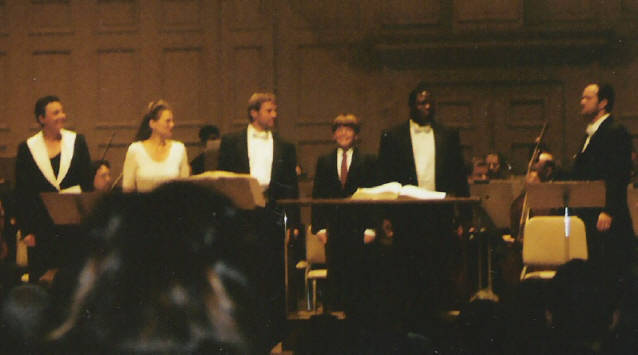
Composer : Claude Debussy
Librettist : A slight alteration of Maeterlinck’s tragedy
Venue and Dates : Boston Symphony Hall
16, 18 October 2003
(Concert Performance)
Conductor : Bernard Haitink
Performers :
Mélisande : Lorraine Hunt Lieberson
Geneviève : Nathalie Stutzmann
Pelléas : Simon Keenlyside
Golaud : Gerald Finley
Arkel : John Tomlinson
Yniold : James Danner
Tanglewood Festival Chorus
Boston Symphony Orchestra
Notes : This performance was broadcast on radio
Soundbites
Click here to read a wonderful and revealing review by Glynnis Rambaud
Jan Swafford for Opera, January 2004
“… Pelléas flowers when he is in love. Simon Keenlyside had a tall order to match Lieberson’s superb vocal acting. For some time he merely sang beautifully, not quite the impetuous youth we want when he bursts in on Mélisande’s solitude with “Moi ! Moi ! Et moi !”. but later in their great, fatal scene by the well, Keenlyside’s fine singing was joined to the drama and he became what Pelléas needs to be: vibrant, drunk with love, but still a boy, a tragic innocent…”
Astonishing Pelleas in Boston
From the Opera-L archives
“Simon Keenlyside was the other great performance, A Pelleas of almost dangerous innocence, a tall young prince of elegant bearing who couldn’t quite suppress a nervousness and growing self-awareness that expressed itself in a telling busyness with the hands, or gestures begun but aborted for fear of revealing too much. Almost alone among the principals, Keenlyside gave an acting performance in this concert setting, in the process making it subtly but very clearly obvious that Pelleas exists in a different reality from those around him. In other words, this was a Pelleas just waiting for a Melisande to happen. Vocally, the man was a miracle. Without any fussiness or affectation he brought an ease and extraordinary ease of dynamic control to the remarkable phrasing that he lavished on this music.”
“His lovely lyric baritone rises with ease to the almost tenorial climaxes required of Pelleas, losing nothing in strength or color as it descends through excellently integrated registers. The final love scene with Melisande, the weight of which falls squarely on Pelleas’s shoulders was by turns ecstatic, heartbreaking, and luminous.”
Extract from On the Beat, Opera News, January 2004, vol 68, no. 7
“Many critics and listeners alike lament that we’re living in the Antiseptic Age of music-making, dominated by streamlined, highly proficient performances that somehow fail to move us on a deep level. Possibly true –– but isn’t it also true that the really galvanizing performances were always somewhat few and far between? In October, I was fortunate enough to hear a performance I consider inarguably, unqualifiedly great: a concert version of Pelléas et Mélisande, with Bernard Haitink conducting the Boston Symphony Orchestra and a cast headed by Lorraine Hunt Lieberson, Simon Keenlyside and Gerald Finley. I heard the performance in Boston (Oct. 18) before it played Carnegie Hall two nights later. Never has Debussy’s mysterious work sprung to life quite so vividly. I have heard other conductors settle for turning the score into a plush pillow of sound –– sumptuous but not always dramatically compelling, and bordering on one-dimensional. Haitink and the BSO, on the other hand, gave a lean, muscular reading that gave full play to the score’s light and dark elements.
A few weeks later, I spoke by telephone with Haitink. He deflects compliments quickly, shifting the focus to the players: “The BSO has something with French music,” he says. “They can play it extremely well. I find it difficult to recommend my own way of conducting. But I do think Pelléas should sound not like an apology but like a real reflection of what is happening in the drama. I do not believe in a Debussy which is vaguely ‘impressionistic’ –– I think it is clear in many ways. It’s a very somber world, but there are bright moments –– the fountain scene, for example. And Debussy has done it with such an incredible lightening up of sound that you simply must do it that way. The best thing when one has to interpret these pieces is to follow the composer. Let him take you by the hand.”
” … And now, the real star of the show: Simon Keenlyside. There is no baritone working in the world today better than Simon Keenlyside. But what about Hvorostovsky? Quasthoff? Hampson? Croft? No, no, no, no. It’s all Keenlyside. His lyric voice is too light for any of the major Verdi roles, but his voice is without a doubt the most beautiful voice I have ever heard, in any fach. Words can’t capture his Pelléas or begin to describe it. He is a singer at the pinnacle of his artistic powers, and I never want it to end. His Pelléas was pure beauty, a luxuriant combination of gold, blue, honey, silk, roses, velvet, water, sky, french horns, cellos. It’s above description. He was like an Apollo in the halo of the stagelights. My eyes seemed to blur every time I looked at him, as if he were one of Dante’s angels—“Clearly I discerned the fair hair of them, but in their faces the eye was dazed, like a faculty which by excess is confounded.”
On Thursday night, he seemed sick (we later found out that he had a cold); he had to blow his nose a lot, and at one point got a lozenge out of his trouser pocket. He also seemed quite fidgety and uncomfortable, pulling at the collar of his tuxedo. But he sounded gorgeous. I didn’t think he could sound better than he did on Thursday night, but on Saturday, he surpassed himself, even though when he wasn’t singing, he sat kind of dejectedly slumped. At least the handkerchief only came out once on Saturday, and that was just to wipe his brow. Pelléas is a difficult role because it starts out too low for most tenors and then, oddly, as Pelléas “becomes a man” it becomes too high for most baritones, but it sounded as if it had been written for Keenlyside. In the Act 4 scene in which Pelléas and Mélisande declare their love for each other, he maintained such a high range so fully, so beautifully, with no sign of strain. It was easily my best opera experience ever. At Pelléas’s climactic, joyous cry of “Je l’ai trouvée!” (he says that he has searched for perfect beauty, and he has finally find it in Mélisande), I was overwhelmed, got covered in goosebumps, and started crying. The hall was saturated in the sheer radiance of his joy. I get goosebumps all over again when I just think about it, and I hope I will be able to hear it in my mind forever. (Please, please, record it!) At first I was worried about his acting, since I wasn’t sure how he’d do in a concert version, what with his acute case of David-Bowie-itis. I saw him in a concert version of Don Carlo earlier this year, and his acting was very minimal then, and he clung to his score. But that was his first Rodrigo, so it’s kind of understandable. In the beginning of Pelléas, he didn’t really have much to do, and he played it kind of fidgety and nervous, like a young man who is youthfully nervous and anxious to meet his brother’s wife, wringing his hands, moving as if unsure of himself. Keenlyside’s Pelléas is childlike, innocent, living in a dream world. I think, ideally, Pelléas and Mélisande should circle each other like undines, clearly in a separate world where Golaud can’t reach them. Only Keenlyside’s Pelléas was living up to his side of the otherworldliness. During their duets together, he would stare at Hunt-Lieberson behind the conductor’s back (a set-up that Keenlyside said he preferred, since the two are often in their own worlds when they’re together), but rather than going all glassy-eyed the way she did when she looked at him, he would subtly react to her words, smiling slightly or looking at her with the awe of first love. His acting was better on Saturday night too, especially when, in Act 4, Pelléas finally tells Mélisande that he loves her. The line is spoken (which is a devastating contrast to Golaud’s only spoken lines—groans of remorse and self-disgust for being responsible for Mélisande’s death), without any musical accompaniment. Keenlyside said “Je t’aime” and then exhaled, almost half-sighed, as if in relief at having finally gotten the words out.His Pelléas grew in intensity as the opera went on, and as the character discovered and gave in to his new feelings, working up to the Act 4 scene, which is just an orgy of euphoria and dizzying happiness (unfortunately, Golaud stabs Pelléas soon after Mélisande confesses that she loves him). And this was when Keenlyside’s performance reached its peak. His body is so wonderfully kinetic; the passion he is portraying fills him from his toes. All his gestures are half-finished, as so often Pelléas’s feelings are half-articulated, half-comprehended, half-answered. It seemed that those gestures often went unfinished as a sign that Pelléas was trying to suppress his true feelings for Mélisande. It seems like he’s testing himself, to see how far he can go, just as Keenlyside was testing the bubbles in his glass of water at the colloquium—he wanted to see how far they could be pushed before they burst. This dangerous passion is first seen in the tower scene with Mélisande, in which Pelléas begins to realize and to speak his love for her. He bathes in it as he bathes himself in the shower of her hair. Keenlyside was surely passionate in this scene, his Pelléas was reveling in his newfound emotions, but it was still a yearning, unrequited passion. When Pelléas got the truth from Mélisande, that truth Golaud wanted so much to hear, Keenlyside let the passion go, makes Pelléas leave everything that was holding him to the earth go. The bubbles exploded. He rocked forward and back, gestured quite wildly with his arms, but it was never too much, because the movements seemed to come from somewhere purely physical and instinctive, never calculated. It was done with such ease, which made it all the more heartbreaking; Pelléas was being carried along by the strength of his love, only to be killed for it. Words are really inadequate, even though I’ve written a lot of them. I had expected that Pelléas et Mélisande would’ve been too subtle, too restrained, as the music at first seems to be. But in truth, it is full of passion, rage, emotion, that is constantly simmering—or festering—as the music flows along, just waiting to flare into a storm. Keenlyside’s Pelléas gave us a storm of passionate love in just two, brief yet completely perfect outbursts, and Finley’s Golaud almost matched him with his terrifying, frustrated, yet oddly pitiful rages. Their passion radiated from them, they poured it forth, as the orchestra poured theirs into their music and held me riveted to my seat as if a beautiful incubus were sitting on my chest, and left me watching with awed and tear-filled eyes.”


{ 0 comments… add one now }